“I do not know what I feel.”
It is one of the most important sentences I hear in the therapy room.
People often think the problem is that they have no emotions.
I think that, most of the time, the emotions are there. They just have not found a language yet.
Sometimes this is where art begins.
Not as a technique.
Not as talent.
But as language.
Some experiences cannot be held by words
If you tried to describe what falling in love feels like, you could probably say a lot.
And still, you might feel that something is missing.
The same is true of deep pain.
Of shame.
Of loss.
Of longing.
Or trauma.
Some experiences are too complex, too contradictory or too early in life to be told as a story.
Not because a person does not want to speak.
But because the psyche does not have the right words yet.
Instead, it can draw.
It can shape something.
It can dance.
It can create an image that says, in one look, what could not be said in many minutes of conversation.
Art is not about aesthetics
One of the biggest fears people have is:
“I do not know how to draw.”
I usually reassure them that I am not interested in whether the drawing is beautiful.
Nor whether it has the right perspective.
Nor whether it looks like something real.
I am interested in something else.
What is the psyche trying to express through this image?
In Jungian psychotherapy, an image is not decoration.
It is a way of thinking.
Sometimes an image tells the truth before the mind is ready to recognise it.
The unconscious speaks in images
We can see the same thing in dreams.
We rarely dream explanations.
We dream of houses.
Forests.
Animals.
Children.
Bridges.
Seas.
Monsters.
The psyche seems to prefer symbols to definitions.
Not because it is confused.
But because some experiences are too rich to fit into one sentence.
I think art uses the same language.
A symbolic language.
A language that does not give quick answers, but can open important questions.
Sometimes the hand knows before the mind
I have seen people start drawing without knowing what they were going to make.
At the end, they looked at the image and said:
“I do not know why I drew this.”
A few minutes later, they began talking about a memory they had not thought about for years.
I do not believe that a drawing knows more than the person.
But I do think it can sometimes reduce the control the mind has over the story.
Then something new appears.
Or perhaps, more accurately, something that was already there becomes visible.
We do not interpret symbols from a dictionary
People sometimes ask me:
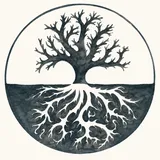
“What does it mean if I drew a tree?”
My answer is almost always the same.
“What does it mean to you?”
Jungian psychology recognises universal symbols.
But every symbol takes on a different shade in each person’s life.
For one person, the sea may mean freedom.
For another, danger.
For someone else, childhood.
I do not believe in automatic interpretations.
I believe in the dialogue between a person and their own image.
Sometimes an image says what a person cannot say yet
There are moments in therapy when the drawing and the story do not match.
The person says they are fine.
The image seems full of tension.
Or they say they are not angry, while the drawing has heavy lines, sharp shapes and a completely different energy.
I do not jump to conclusions.
But I become curious.
Maybe there is a part of the psyche trying to be heard.
I do not think the drawing tells the truth while the words lie.
I think each one expresses part of the truth.
Therapy often begins in the space between them.
Creativity does not belong only to artists
When I say “creativity”, many people think of painters, sculptors or musicians.
I think it is something much deeper.
Creativity is the psyche’s ability to find a new form.
A new point of view.
A new answer.
A new life.
That is why, in psychotherapy, creating is not only about drawing.
It is about the possibility of leaving an old pattern.
In a way, every person who begins to live differently creates their own work of art.
Why do I sometimes use art in therapy?
Because some people have spent years trying to explain their pain.
And still, something remains unsaid.
Not because they were not intelligent enough.
But because some things do not need explanations at first.
They need an image.
A gesture.
A colour.
A shape.
Words can come later.
I think this is one of the most beautiful powers of creating.
Not the power to produce beautiful objects.
But the power to make visible what, until then, lived only in silence.
And sometimes, when that thing becomes visible, healing begins too.